

Overview
Puppies grow fast, but when do dogs stop growing exactly? It depends on their breed, size, and a few other factors like nutrition and neutering. Most reach their full height in the first year, but some, particularly larger breeds, carry on developing well into their second.
Growth timelines by breed size
Dogs don’t all follow the “one year = adult” rule. Smaller breeds grow up much faster than large or giant ones.
Breed size and examples | When they stop growing |
Toy (Chihuahua, Yorkshire Terrier) | 6–9 months |
Small (Pug, Jack Russell Terrier) | 8–12 months |
Medium (Bulldog, Border Collie) | Around 12 months |
12–18 months | |
Giant (Great Dane, Mastiff) | 18–24 months |
Even once height growth slows, puppies continue to develop. They gain muscle and fill out, particularly larger breeds that can look lanky during adolescence. Full adult weight is typically reached between 18 months and two years.
How big will my puppy get?
It’s the question every owner asks: how big will my puppy get?
Here are a few ways to estimate it:
Breed and genetics: If your puppy is a purebred, you can use breed standards and the size of their parents as a guide. Males usually grow slightly larger than females.
Mixed breeds: Without breed information, it’s more challenging to determine. If you know anything about your pup’s parents, you may be able to use the average of their parents size/weight to make a rough estimate as to their own adult weight, but this can vary. Clues like paw size, birth weight, or growth plates (your vet can check these) can also help — but results vary.
Rule of thumb: For small breeds, multiply their eight-week weight by three. For larger breeds, double their weight at 16 weeks. These are ballpark figures and should be used with care.
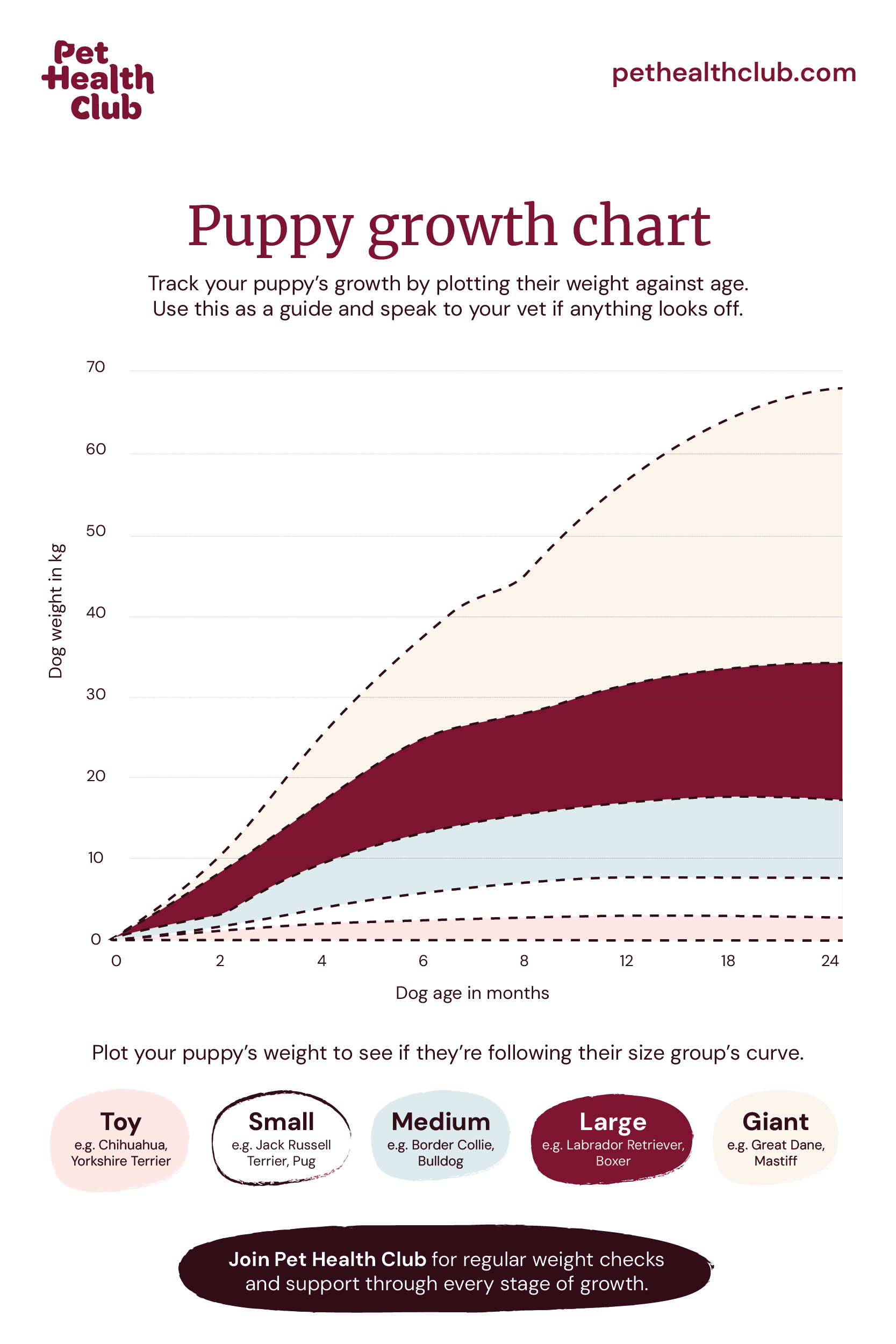
Growth charts: Vets use puppy growth charts based on size category to track progress. These help spot under- or over-growth and are handy to have during vet check-ups.
Read more: Dog breed guides
How genetics shape growth
Your puppy’s genes largely decide how big they’ll get. Breed size and parental size are the main indicators. Even within a litter, some puppies may inherit different growth patterns. Males usually grow taller than females, and some puppies may carry genes that affect growth speed or bone development.
Nutrition makes a big difference
Feeding your puppy a balanced, size-appropriate diet is key. Here’s what to keep in mind:
Use a puppy-specific complete food as these have the right nutrients to support bone and brain development.
Large breed pups need special care and will benefit from formulas with lower fat and calcium to avoid growing too fast, which can harm their joints.
Monitor their weight, as overfeeding can lead to health issues in the future, particularly joint problems in larger breeds. On the other hand, pesky parasites can take your puppy's nutrients for themselves, and can even cause malnutrition, anaemia, or stunted growth — this is why worming your puppy and keeping on top of their flea treatment is so important.
Use growth charts to track your puppy's development. If they are gaining weight too quickly or not quickly enough, talk to your vet.
Most puppies move to adult food once they’re close to their final size – usually 10 to 12 months for small breeds, and up to 24 months for giants.
Impact of neutering on growth
Neutering your puppy can delay the closing of growth plates, which may make them grow slightly taller. This effect is more noticeable in large breeds. For these dogs, vets may recommend waiting until around 18-24 months to neuter, once the bones have fully developed. Regardless of timing, neutering can also slow metabolism, so it’s important to monitor weight and adjust food intake accordingly.
Exercise and health matter too
Regular but gentle activity supports bone strength and healthy muscle development. Too much high-impact exercise can harm growing joints, especially in large breeds.
Health checks and vaccinations ensure your puppy stays parasite-free and avoids growth-stunting illnesses. Early health checks are also a great time to discuss your puppy’s diet with the vet.
Falls or rough play that injure growth plates can lead to abnormal bone development.
Happy and stress-free puppies eat better and grow more steadily, so a calm home environment helps too.
Tracking your puppy’s progress
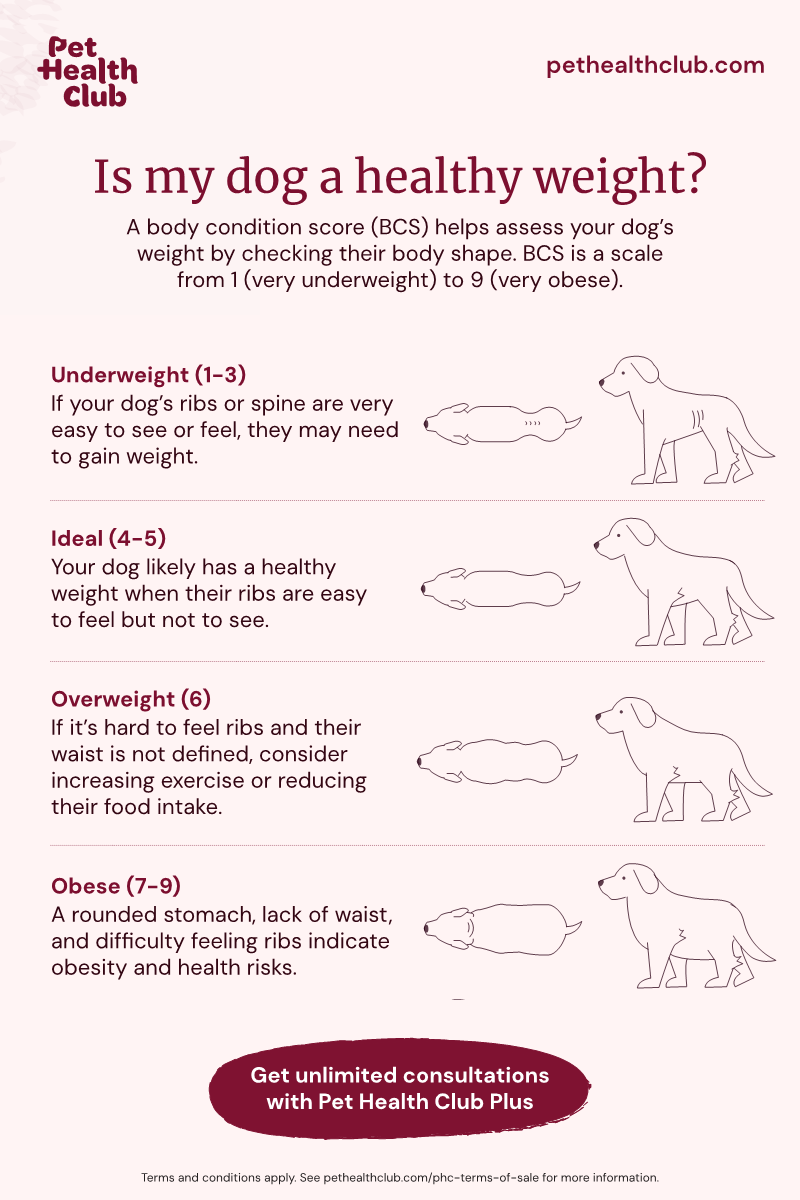
Keep an eye on your puppy’s growth by weighing them regularly, starting with every week or two at first, and then monthly as they get older. Alongside the numbers, check their shape using a body condition score chart. You should be able to feel their ribs easily, but not see them. Routine vet visits are a good opportunity to track growth and ask whether their development is on the right path. And if your puppy starts gaining weight too fast or looking a bit too lean, don’t wait as small changes to food or routine now can make a big difference later. Your vet can also use growth charts to check your puppy’s weight is staying on a healthy track for their breed size.
Read more: Is my dog overweight?
Weight vs. maturity: why size isn’t the full story
If you’re wondering what age do dogs stop growing, it’s helpful to know that reaching full weight doesn’t mean your dog is fully mature. While many large and giant breed puppies reach around 99% of their adult weight by 12 to 15 months, that doesn’t mean they’re fully grown. Their bones, joints, and muscles continue to develop well into their second year. That’s why vets often recommend feeding large breed puppy food, and avoiding intense exercise, until around 18 to 24 months, especially for breeds like Great Danes, Mastiffs and Irish Wolfhounds. So even if your puppy looks full-sized, their bones may still be growing and developing strength underneath.
What science says about puppy growth
It’s not one size fits all
This report shows that puppies grow at different speeds depending on their breed, and it’s not just about size. While small dogs like Papillons may reach adult weight by nine months, larger breeds like Newfoundlands can keep growing until well over 15 months. Even dogs of a similar size can grow at different rates. That’s why it’s important to follow feeding advice tailored to your dog’s breed and life stage.
Why early growth matters
This report on puppy growth found that the first few weeks are critical, with steady weight gain showing things are on track. Puppies should ideally gain around 10% of their body weight each day, especially after the first 48 hours after birth. A sudden weight loss can signal a potential health issue. Regular weighing helps you and your vet spot any changes quickly, giving your puppy the best possible start.
Track progress with growth charts
Another report recommended using puppy growth charts based on bodyweight and breed size to track your dog’s growth from 12 weeks to two years, making it easier to spot if they’re gaining too much, or too little, weight. By following a healthy growth curve, you can reduce the risk of problems later on. Ask your vet to show you the right chart for your dog and how to use it at home.
Need more information?
Most puppies stop growing in height between six and 18 months, depending on their breed. Good nutrition, tailored exercise, and regular check-ups are the building blocks for a healthy adult dog.
Want to know when your dog will stop growing or how to support them through every stage? Speak to your local vet. You can find your nearest practice using our find a vet tool. And if you haven’t already, consider joining the Pet Health Club. With unlimited consultations, regular health checks, and preventative care built in, it’s a simple way to support your puppy’s healthy start, and every stage that follows.
Join the club today
Get regular health checks, vaccinations, and more, all included in your plan.

Show references
Alves, I. (2020) ‘A model of puppy growth during the first three weeks’, Veterinary Medicine and Science, 6(6), pp. 946–957. doi:10.1002/vms3.349.
Salt, C., Morris, P.J., German, A.J., Wilson, D., Lund, E.M., Cole, T.J. and Butterwick, R.F. (2017) ‘Growth standard charts for monitoring bodyweight in dogs of different sizes’, PLOS ONE, 12(9), p. e0182064. doi:10.1371/journal.pone.0182064.
Butterwick, R.F., German, A.J., Salt, C., et al. (2023) ‘Growth patterns in dogs: variation among breeds and implications for feeding guidelines’, The Journal of Nutrition. doi:10.1016/j.jn.2023.03.007.
American Kennel Club (AKC), 2022. When Does My Puppy Finish Growing? Available at: https://www.akc.org/expert-advice/puppy-information/when-do-puppies-stop-growing/
American Kennel Club (AKC), 2023. Growth Plates in Puppies: What You Need to Know. Available at: https://www.akc.org/expert-advice/health/growth-plates-in-puppies/
Elanco Animal Health, 2023. Your Pet and You – Puppy Development Timeline. Available at: https://www.yourpetandyou.elanco.com/uk/puppy/puppy-development-timeline
Freeman, L., 2022. Growth Guide: Keeping Your Puppy on Track. Petfoodology, Tufts University. Available at: https://vetnutrition.tufts.edu/2022/03/puppy-growth-guide/
German, A.J., Holden, S.L., et al., 2021. A New Growth Standard for Puppies. PLOS ONE, 16(2), pp.1–17. Available at: https://journals.plos.org/plosone/article?id=10.1371/journal.pone.0249224
WALTHAM Petcare Science Institute, 2023. Growth Standards for Puppies. Available at: https://www.waltham.com/resources/puppy-growth-charts/
Hart, B.L., Hart, L.A., et al., 2020. Neutering Dogs: Effects on Joint Disorders and Cancers. Frontiers in Veterinary Science, 7, pp.1–11. Available at: https://www.frontiersin.org/articles/10.3389/fvets.2020.00388/full
Moxon, R., German, A.J. and et al., 2023. Prepubertal Spay/Neuter and Growth in Guide Dogs. Journal of Veterinary Internal Medicine, 37(3), pp.1080–1090. Available at: https://doi.org/10.1111/jvim.16753
Colorado State University, 2018. Spaying and Neutering: Timing and Long-Term Effects. Phys.org. Available at: https://phys.org/news/2018-01-spaying-neutering-dogs-affects-growth.html
UC Davis Veterinary Medicine, 2021. Early Neutering and Orthopedic Disease. Available at: https://www.vetmed.ucdavis.edu/news/early-neutering-and-dog-health
Merck Veterinary Manual, 2023. Puppy Growth and Development. Available at: https://www.merckvetmanual.com/management-and-nutrition/management-of-the-puppy-and-kitten/growth-and-development-in-puppies
WSAVA, 2022. Body Condition Score (BCS) Guidelines. World Small Animal Veterinary Association. Available at: https://wsava.org/global-guidelines/global-nutrition-guidelines/body-condition-score/
Texas A&M University School of Veterinary Medicine, 2022. The Puppy Timeline: Milestones in Growth. Available at: https://vetmed.tamu.edu/news/pet-talk/the-puppy-timeline/
PennVet, University of Pennsylvania, 2021. Feeding the Growing Puppy. Available at: https://www.vet.upenn.edu/docs/default-source/ryan/documents/puppy-nutrition-guide.pdf
Medically reviewed by Lizzie Youens, BSc(Hons) BVSc MRCVS
Published on 15/05/2025 • Reviewed on 15/05/2025