

Overview
Around 30% of dogs seen for reproductive concerns show signs of phantom pregnancy — so if your dog is going through this, she’s not alone. It’s a surprisingly common condition, where dogs start nesting, producing milk, or mothering toys — without actually being pregnant. These changes are caused by normal hormone shifts after she’s been in heat. In most cases, there’s no need to worry — the symptoms usually settle down on their own.
Phantom pregnancy, or pseudopregnancy, usually shows up around six to eight weeks after a dog’s season. While some dogs show physical signs, many don’t. In fact, 96% of vets have seen cases with only behavioural symptoms, and 97% have seen aggression as a symptom. Some breeds — like Afghan Hounds, Beagles, Boxers, and Dachshunds — can be more likely to experience it, with up to 75% affected. Despite this, phantom pregnancy can affect any female dog, whether she’s had puppies before or not. Spaying, once symptoms have passed, is the most reliable way to prevent phantom pregnancies from happening again.
What is phantom pregnancy in dogs?
Phantom pregnancy occurs when a female dog shows signs of pregnancy despite not being pregnant. It usually happens in unspayed dogs and is caused by natural hormonal changes following a heat cycle. These hormonal shifts can then lead to physical and behavioural symptoms like those seen in pregnancy.
During a phantom pregnancy, dogs might display nesting behaviour or milk production, and sometimes they might even gain weight. Some dogs may appear restless or anxious, while others might display protective behaviour over toys or bedding, as though they were caring for puppies.
The symptoms can vary from mild to very convincing, which often leaves owners confused, especially if they know their dog hasn’t mated. In most cases, phantom pregnancy in dogs is a normal, temporary condition, but it can still cause alarm for both dog and owner.
Read more: Dog neutering guide
What causes phantom pregnancy in dogs?
Phantom pregnancy in dogs is caused by natural hormonal changes that happen after a female dog finishes her heat cycle. After ovulation, the hormone progesterone rises to prepare the body for pregnancy, even if your dog hasn’t mated. These high levels of progesterone remain for several weeks.
As progesterone levels drop, another hormone called prolactin increases. Prolactin is responsible for the physical and behavioural signs of pregnancy, such as enlarged mammary glands, lactation, and nesting behaviour. It is not fully understood why pseudopregnancy happens, but it is likely due to a combination of lowering progesterone levels, high prolactin levels and an increased sensitivity to prolactin.
These hormonal changes can also sometimes be triggered if a dog is spayed at a certain point in her heat cycle, particularly when progesterone levels are still high. The sudden hormonal shift after surgery can, in some cases, cause a phantom pregnancy.
Interestingly, not all dogs experience phantom pregnancy, and the reasons why some are affected and others aren’t remain unclear. Some experts believe phantom pregnancy in dogs may have had an evolutionary origin. These theories suggest that, in the wild, females within a pack who weren’t pregnant could still help care for puppies by providing milk — or even by defending other puppies as if they were her own. If these experts are right, phantom pregnancies might have increased the survival chances of the pack.
How long does a phantom pregnancy last in dogs?
Phantom pregnancy in dogs typically occurs six to eight weeks after a heat cycle. This is when hormonal changes reach a point where signs of pregnancy, despite no mating, may begin to appear. The symptoms can then last anywhere from one to four weeks, depending on your dog and the severity of her condition. In some cases, the signs may resolve quickly, while in others, they can be more persistent.
Some dogs experience phantom pregnancy repeatedly after each heat cycle unless they are spayed. It can occur at any age after your dog has had her first season, though it doesn't necessarily happen after every cycle. Even in the same dog, the severity and duration of symptoms can vary from one season to the next.
If symptoms seem to last beyond the usual timeframe, or worsen significantly, it’s always recommended to consult your vet, as this could indicate another health concern.
What are the signs of phantom pregnancy in dogs?
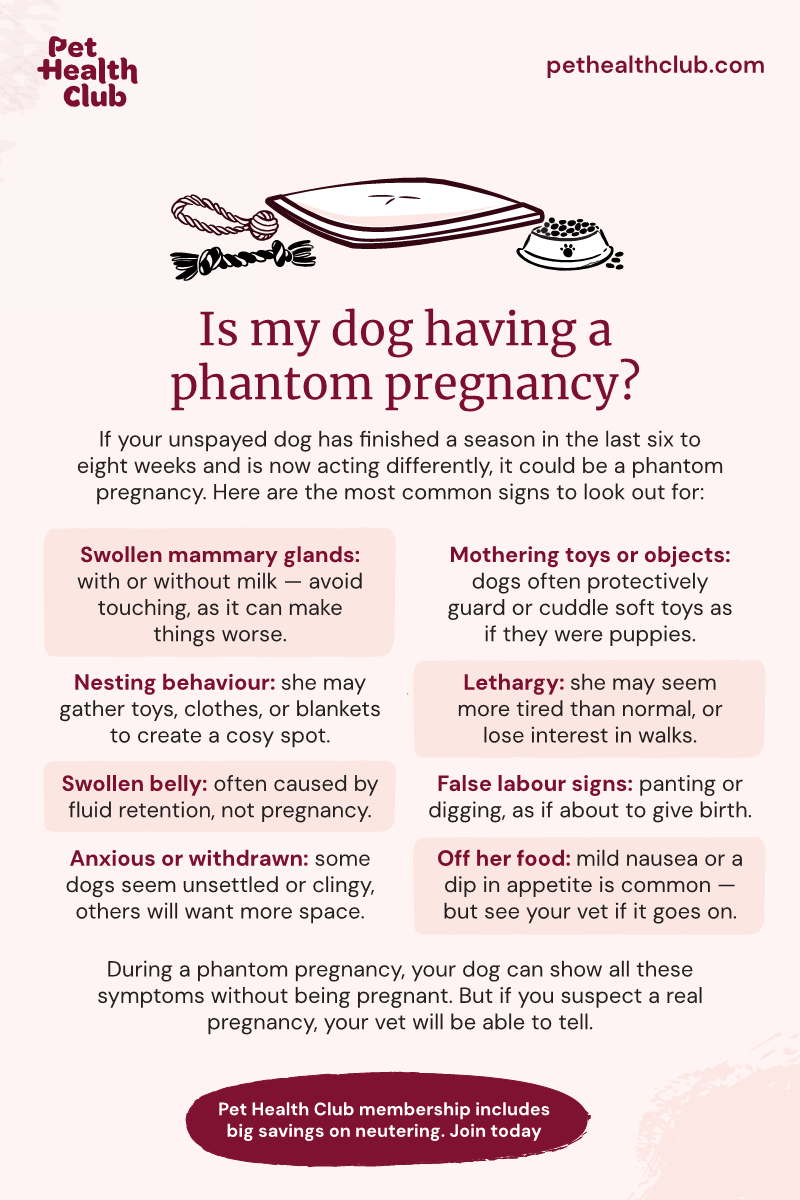
Phantom pregnancy can cause both physical and behavioural changes.
Common physical signs to look out for include:
Swollen mammary glands, with or without milk production
Loss of appetite
Less commonly, you may notice lethargy or low energy, weight gain, a swollen belly due to fluid retention, or nausea/vomiting
Common behavioural signs include:
Nesting behaviours, such as gathering toys, blankets, or clothing to create a nest
Mothering objects like toys or other items
Restlessness, nervousness, or anxiety
Reduced interest in play or walks, or, conversely, an increase in activity
Protective or aggressive behaviour, particularly around nests or toys
Many of these symptoms closely mimic a real pregnancy, which is why it can be difficult to tell them apart without veterinary advice. If you're unsure whether your dog is experiencing a phantom pregnancy or a true pregnancy, always speak to your vet.
Read more: How to help your dog through her pregnancy
Is phantom pregnancy bad for dogs?
Phantom pregnancy can have a bad effect on your dog's well-being. Physically, symptoms like swollen mammary glands, fluid retention, nausea and lethargy can leave your dog feeling uncomfortable and low in energy. If milk production isn't managed, it can lead to complications like mastitis, a painful infection of the mammary glands that requires veterinary treatment.
Behaviourally, phantom pregnancy can cause confusion, restlessness, and even anxiety. Some dogs become protective or aggressive around toys or nesting spaces, which can be upsetting for families, especially in multi-pet households. Others may seem withdrawn, lose their appetite, or stop wanting to play or be sociable. For most dogs, these feelings pass within a few weeks, but if your dog seems really unsettled or the symptoms are lasting, it’s always best to check in with your vet.
If you are worried about the long-term effects of phantom pregnancy, you may want to talk to your vet about having your dog spayed — and it’s worth knowing that members of Pet Health Club get up to 30% off neutering.
How can phantom pregnancy in dogs be treated?
In many cases, phantom pregnancies resolve on their own within two to three weeks, especially if symptoms are mild. However, treatment may be needed if symptoms are severe, persistent, or causing distress. Your vet may recommend:
Medication to reduce hormone levels, intended to block the effects of prolactin and stop milk production
Using a recovery suit, inflatable collar, or cone to prevent licking of the mammary glands, as this can prolong milk production
Avoiding stroking, bathing, or any stimulation of the mammary area
Removing toys the dog is mothering, ideally while she is distracted, to avoid causing distress
Providing extra exercise and mental stimulation to distract from nesting behaviour
In some persistent or severe cases, medication to reduce fluid retention (these are called diuretics) or mild sedatives to ease anxiety may be considered
The most effective long-term solution for preventing phantom pregnancy is to have your dog spayed. However, spaying should only be done once all signs of phantom pregnancy have fully resolved, as operating during a phantom pregnancy can prolong symptoms.
How to prevent phantom pregnancy in dogs?
The most effective way to prevent phantom pregnancy in dogs is to have your dog spayed (neutered). Spaying involves removing the ovaries and uterus (an ovariohysterectomy), or just the ovaries if performed via keyhole surgery (an ovariectomy), which stops heat cycles and prevents the hormonal changes that trigger phantom pregnancies.
Spaying is usually recommended after your dog's first season, often around six to twelve months of age, though this can vary depending on the breed. If your dog has already shown signs of phantom pregnancy, it's essential to wait until all symptoms have fully resolved before arranging the procedure. Spaying during a phantom pregnancy can actually prolong the symptoms or cause them to persist.
In addition to preventing phantom pregnancies, spaying significantly reduces the risk of other health problems, including womb infections (pyometra), mammary tumours, ovarian cancer, and unplanned litters.
There are currently no reliable, non-surgical methods to prevent phantom pregnancy in dogs. While management techniques like avoiding overstimulation of the mammary glands and discouraging mothering behaviour with toys can help reduce symptoms, they do not prevent future episodes.
If you're unsure about the timing of spaying or have concerns about your dog's risk of phantom pregnancy, speak to your vet. They can provide personalised advice based on your dog's age, breed, and health. And remember, Pet Health Club has discounts of up to 20% on neutering.

Read more: Guide to your dog's first heat cycle
FAQs about phantom pregnancy in dogs
Is phantom pregnancy stressful for dogs?
It can be. Some dogs feel anxious, restless, or low in energy, and it’s not unusual for them to become protective of toys or nesting spots. Others may seem a bit withdrawn or off their food. Repeated phantom pregnancies can also cause ongoing stress and confusion for both the dog and their owner, and can affect relationships with other dogs in a multi-pet household. Over time, this may affect your dog's emotional well-being, as well as increasing the risk of mammary-related health issues.
Can phantom pregnancy happen after my dog has been spayed?
Yes, but only if spaying is done at the wrong time in your dog's heat cycle — particularly when progesterone levels are still high. This hormonal shift can sometimes trigger a phantom pregnancy. Your vet can advise on the safest timing.
Will my dog have phantom pregnancies after every season?
Not necessarily. Some dogs only experience them occasionally, while others have them after each heat cycle. It varies from dog to dog.
Is it safe to leave my dog with toys she's mothering?
It's generally recommended to gently remove toys your dog is mothering, as this can help reduce her symptoms. However, it's important to do this without causing distress. Distract her with walks or games, and remove the toys while she's occupied.
Can phantom pregnancy cause symptoms that seem like a health emergency?
Yes, while most symptoms are mild, signs like severe lethargy, loss of appetite, vomiting, or discharge from the vulva could indicate a more serious issue. Always contact your vet if you're concerned.
How soon after a phantom pregnancy can my dog be spayed?
You should wait until all signs of phantom pregnancy have completely resolved before arranging spaying. Spaying too soon can prolong the symptoms.
What do studies on phantom pregnancy in dogs say?
Recent studies show that phantom pregnancy in dogs is common and often goes unrecognised. A large UK survey from 2018 found that nearly all vets regularly see cases, with signs ranging from physical changes like swollen mammary glands to behavioural changes such as nesting, mothering toys, or even aggression. Interestingly, dogs can show behavioural signs without any obvious physical changes, so it’s important for owners to be aware of both.
A 2018 UK study highlights just how common phantom pregnancy is, with 97% of vets reporting at least one case in the past year and an average of 10 cases each. While physical signs like enlarged mammary glands were seen in most dogs, 96% of vets had also seen cases showing only behavioural symptoms — such as nesting or carrying toys. Aggression was another frequently reported issue, noted by 97% of vets. The findings suggest that some breeds, including Afghan Hounds, Beagles, Boxers, and Dachshunds, may be more prone to phantom pregnancy, with rates in the UK as high as 75%. The study also found that phantom pregnancy doesn’t just affect unneutered dogs — 49% of vets had seen it in spayed dogs too, especially when surgery was done during a certain stage of the heat cycle
A 2024 study from Spain found that phantom pregnancy affects around 30% of dogs seen for reproductive concerns. It also confirmed that phantom pregnancy can happen in spayed dogs, especially if they were spayed at the wrong time in their heat cycle, when certain hormones are still high. That’s why vets recommend waiting until all signs of phantom pregnancy have completely cleared before having your dog spayed.
A Nigerian study from 2019 suggests that a dog’s age, breed, and reproductive history may all influence the chances of experiencing phantom pregnancy. In this study, over 86% of cases were seen in dogs that had never had a litter before. The study also found certain breeds appeared more prone to phantom pregnancy — and these were different from the most commonly affected breeds in the UK. German and Russian Shepherds made up the majority of Nigerian cases recorded, while the condition was less common in breeds like Mastiffs and Rottweilers.
When it comes to treatment, research shows there are a number of safe and effective options available. While medication to reduce milk production and swelling is commonly used, a 2020 Brazilian study explored Vitamin B6 (pyridoxine) as a promising alternative. It was found to work just as well as traditional treatments in managing physical signs of phantom pregnancy, with no reported side effects and at a lower cost. However, more research is needed on this, every dog is different, and your vet will recommend the best treatment based on your dog's specific needs and circumstances.
Need more info?
For expert advice on phantom pregnancies and dog spaying, contact your local vet. And remember, Pet Health Club members get up to 20% off neutering. Find your nearest Pet Health Club vet using our Find a Vet page.
Join the club today
Get regular health checks, vaccinations, and more, all included in your plan.

Medically reviewed by Lizzie Youens, BSc(Hons) BVSc MRCVS
Published on 01/10/2021 • Reviewed on 23/07/2025