

Overview
Vaccinating your cat is one of the best ways to protect them from serious and potentially life-threatening diseases. These illnesses — like feline parvovirus, feline herpesvirus, and feline leukaemia virus — can cause lasting health issues and can sometimes be fatal.
Vaccines also help prevent the spread of disease within the broader cat population. This protection is especially helpful in areas with lots of cats.
Core vs. non-core vaccines
Core vaccinations are recommended for all cats, regardless of whether they stay indoors or go outside.
Core vaccines protect against highly contagious diseases with serious health impacts. These include feline leukaemia, feline parvovirus (also known as infectious enteritis or feline panleukopenia), and the main diseases behind cat flu — feline herpesvirus and feline calicivirus. All core vaccines and boosters are included in Pet Health Club membership.
Non-core vaccines are recommended based on your cat’s lifestyle — if your cat spends time outdoors or meets other cats, for example, extra vaccines may be needed to reduce the risk of other infections. The most common non-core vaccines include those for rabies, a disease not present in the UK but a risk to cats travelling abroad, and Chlamydophila felis, which is more prevalent in homes with more than one cat.
Read more: Cat vaccination FAQs
Which vaccinations does my cat need?
Vaccines for cats are available for several diseases, including:
Chlamydophila felis
Bordetella bronchiseptica
Rabies
The primary cat inoculations Pet Health Club members receive as part of their benefits cover:
Feline parvovirus (FPV)
Feline rhinotracheitis (FHV)
Feline calicivirus (FCV)
Feline leukaemia virus (FeLV)
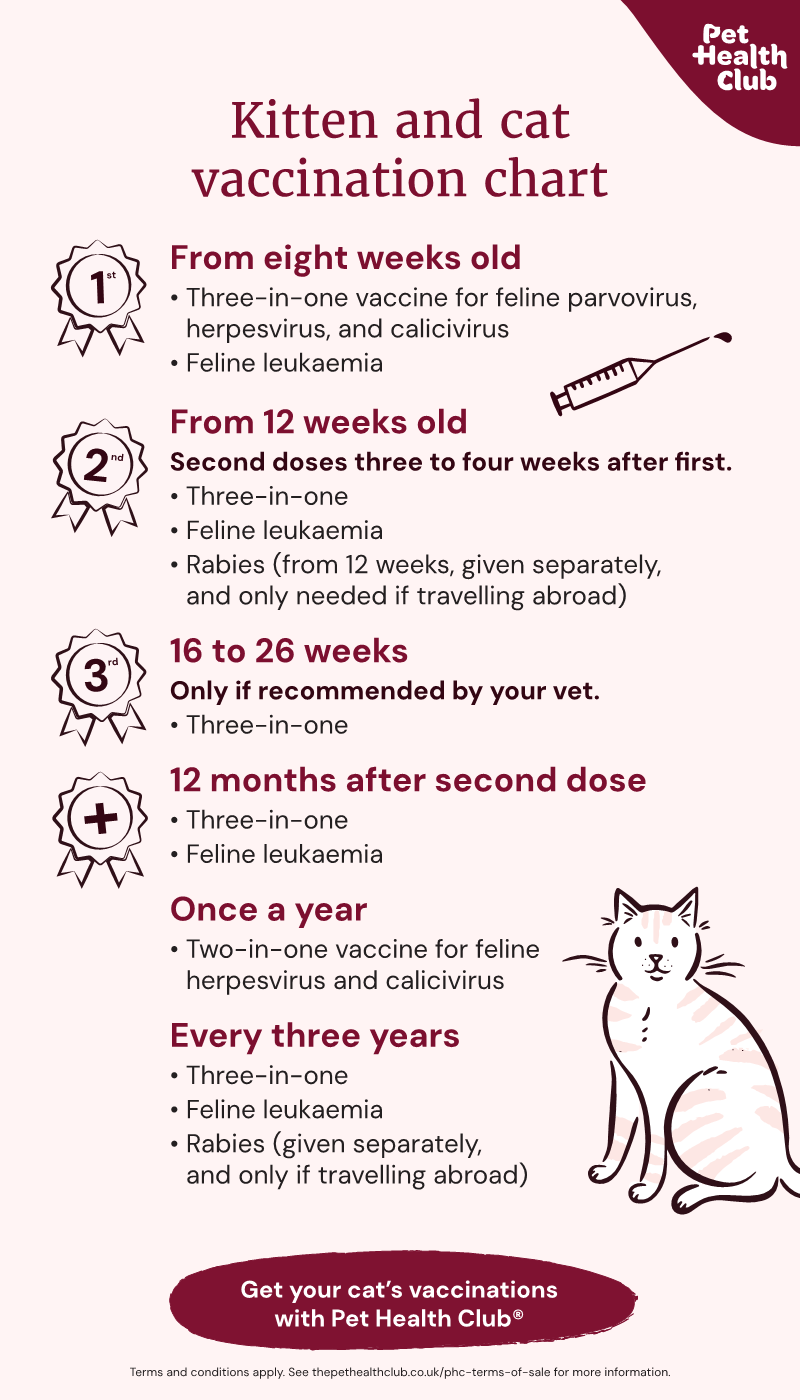
Kitten vaccination timeline
It’s important for kittens to follow a set vaccination schedule to provide them with strong, lasting immunity. Once their starter course is complete, and they've been neutered, you'll can start thinking about letting your kitten outside for the first time.
First vaccination: from eight weeks old
Vaccines: feline leukaemia, and a three-in-one covering feline parvovirus, feline herpesvirus, and calicivirus.
Why: these illnesses are particularly dangerous for young kittens with immature immune systems. Feline parvovirus, for example, can cause severe vomiting, diarrhoea, and dehydration and is often fatal without vaccination. Meanwhile, feline leukaemia can lead to serious health issues like lymphoma and immunosuppression.
Second vaccination: from 12 weeks old
Vaccines: feline leukaemia, and the three-in-one including feline parvovirus, feline herpesvirus, and calicivirus.
Why: a booster dose strengthens initial immunity. The second vaccination should be given three to four weeks after the first. From this time, your kitten can receive their first rabies vaccine too, but this is only required if you actively plan to travel abroad. When needed, rabies vaccines will be given separately.
Third vaccination: 16 to 26 weeks old
A third vaccine is not always needed, but your vet may recommend one depending on your kitten’s risk factors or response to earlier vaccines.
Vaccines: three-in-one covering feline parvovirus, feline herpesvirus, calicivirus.
Why: this final booster helps give kittens lasting immunity, and a strong defence as they grow and explore new environments.
One-year booster: 12 months after second dose
Vaccines: feline leukaemia, and the three-in-one for feline parvovirus, feline herpesvirus, and calicivirus.
Why: the one-year booster supports lasting immunity as kittens reach adulthood.
Vaccination for adult cats
After the first year, adult cats usually need fewer vaccinations, with boosters given at regular intervals to maintain protection. For most adult cats, a two-in-one flu booster (covering feline calicivirus and feline herpesvirus) are needed every year.
Other vaccines, such as for parvovirus and feline leukaemia, are usually given every three years. Rabies vaccines are usually given every three years as well, but only for cats who travel abroad. Rabies vaccines are always given separately.
Rabies vaccine for travelling cats
The UK is rabies-free so cats don’t usually need a rabies vaccine. However, the rabies vaccination is required for most destinations if your cat is travelling abroad. Check the specific requirements for the country you’re visiting well in advance, as some countries may have additional guidelines regarding the timing of vaccinations.
Need more info on your cat’s vaccinations?
For more advice on kitten vaccinations and keeping your cat protected against illness and infection, have a chat with your local vet.
Find your nearest vet using our Find a Vet page.
Join the club today
Get regular health checks, vaccinations, and more, all included in your plan.

Medically reviewed by Lizzie Youens, BSc(Hons) BVSc MRCVS
Published on 03/11/2024 • Reviewed on 26/04/2026