
Overview
Your dog's nails might not be top of mind when thinking about their health, but they should be. If left unchecked, unhealthy dog nails can lead to pain, infections, and mobility issues. Signs include long, curling claws, cracks, rough edges, discolouration, and swelling at the nail base.
Broken nails in dogs may bleed, cause limping, or lead to licking and discomfort. Knowing the difference between healthy vs unhealthy dog nails helps you spot problems early and care for them safely at home. Regular trims, checks, and vet support can all play a part in keeping your dog comfortable and pain-free.
What are the symptoms of unhealthy dog nails?
Not all nail problems are obvious straight away. But knowing the signs can help you spot them early:
Nails that are too long and start curling under or sideways
Cracks, splits or rough edges
Red or swollen skin around the base of the nail, sometimes with discharge
Nails that change colour — turning yellow, brown, or showing dark streaks
Thickened or crumbly nails that break easily
You might also notice your dog limping, reacting unusually when you touch their feet, licking their paws more often, or hesitating on walks. These are signs something might not feel quite right.
Healthy vs unhealthy dog nails — what's the difference?
Healthy nails tend to look neat, smooth, slightly curved, and short enough that they don’t constantly touch the ground. The colour should be even across each nail, whether they’re black, white, or brown.
Unhealthy nails often look different: rough, flaky, too long, or oddly shaped. If your dog flinches when you touch their paws, it could be a sign of discomfort.
Images of healthy and unhealthy nails can help you learn what’s normal for your dog. Sudden changes, especially if they’re painful, are worth checking.
What causes nail problems in dogs?
Lots of things can lead to nail issues:
Nails that aren’t trimmed often enough can grow too long and snag
A torn or cracked nail can let bacteria in and lead to infection
Allergies can cause dogs to lick or chew their paws, irritating the skin at the base of the nails
Some health conditions, like thyroid problems, can affect how nails grow
Poor nutrition can lead to brittle or weak nails
Sometimes, it’s a mix of things. And injuries, like catching a nail on something while playing, can happen to any dog, even if you’re doing everything right.
Read more: How to clean your dog's ears
How do you care for your dog’s nails?
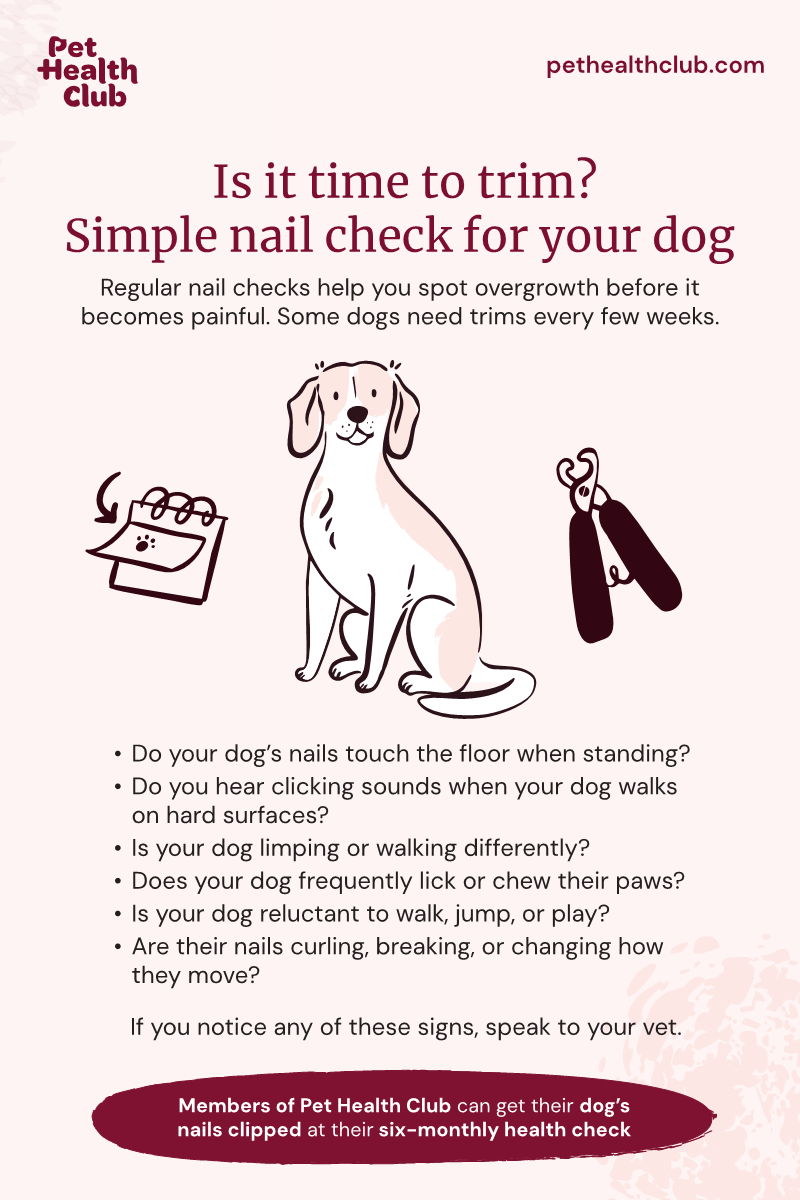
Keeping your dog’s nails in good shape doesn’t need to be complicated. Start with regular checks, every couple of weeks is a good rule of thumb. If you hear tapping on the floor, it’s probably time for a trim.
Use a sharp pair of dog nail clippers or a nail grinder. Only take off a little at a time, especially with dark nails where you can’t see the quick. Don’t forget the dewclaws, those higher-up nails that don’t touch the ground but still need trimming.
If your dog is walked regularly on harder surfaces (such as pavement), they may not need regular nail trimming — but their nails still need checking often for signs of problems.
Try to make nail care positive. First, practise lifting their paws and handling their nails without clipping them. Let your dog sniff the clippers, go slowly, and offer treats and praise. If you’d prefer some help, Pet Health Club practices offer nurse-led nail clipping as part of a routine check-up.

Read more: Signs your dog is in pain
My dog has unhealthy nails — when should I call my vet?
Sometimes nail issues need a bit more support. Get in touch with your vet if:
Your dog is limping or avoiding putting weight on a paw
Your dog reacts badly or unusually when you touch their paw or nail
There’s bleeding, swelling or pus around the nail
A nail has grown into the paw pad
Several nails are changing shape or falling off
Can I treat unhealthy dog nails at home?
If there’s bleeding, gently press with a clean cloth and use styptic powder or cornflour to stop it. Trim any sharp edges if your dog is calm and relaxed. Clean the area with lukewarm water and try to prevent licking by using a clean sock or a buster collar. Keep a close eye on the nail for the next few days, clean it regularly with water and monitor for redness, swelling or discharge. If the nail is very painful, broken near the base, still bleeding after a few minutes, or you can’t stop your dog licking it, contact your vet, as this will help prevent infection and ease discomfort.
Need more information about unhealthy dog nails?
Nail care is a small thing that has a big impact. By keeping on top of regular checks and trims, you’ll help your dog stay comfortable and active. And if you’re ever unsure, your local vet team is there to support you.
Pet Health Club members enjoy six-monthly health checks and nail clipping as part of their plan. Regular visits help catch issues early and keep your dog comfortable on their paws. To find your nearest Pet Health Club practice, use our Find a vet tool.
Join the club today
Get regular health checks, vaccinations, and more, all included in your plan.

Show references
American Animal Hospital Association (AAHA), 2020. AAHA Canine Life Stage Guidelines. [online] Available at: https://www.aaha.org [Accessed 14 June 2025].
American Veterinary Medical Association (AVMA), 2022. Basic Preventive Care for Dogs. [online] Available at: https://www.avma.org [Accessed 14 June 2025].
Cote, E., 2019. Clinical Veterinary Advisor: Dogs and Cats. 4th ed. St. Louis: Elsevier.
Hall, J.A., 2021. The Merck Veterinary Manual. 11th ed. Merck & Co., Inc. [online] Available at: https://www.merckvetmanual.com [Accessed 14 June 2025].
Rees, C.A., Shofer, F.S., and Rees, L., 2002. Onychodystrophy in dogs: 29 cases (1988–1998). Journal of the American Veterinary Medical Association, 220(3), pp.357–361.
Scott, D.W., Miller, W.H. and Griffin, C.E., 2001. Muller and Kirk’s Small Animal Dermatology. 6th ed. Philadelphia: Saunders.
White, S.D. and Bourdeau, P., 2003. Symmetrical lupoid onychodystrophy in dogs. Compendium on Continuing Education for the Practicing Veterinarian, 25(6), pp.436–444.
Medically reviewed by Lizzie Youens, BSc(Hons) BVSc MRCVS
Published on 22/07/2025 • Reviewed on 22/07/2025