

Overview
No dog needs to be neutered as a rule, and the signs discussed here are not guarantees. But if you're not planning to breed from your dog, certain behaviours or health changes may be good reasons to have a conversation with your vet. These include behavioural habits, health conditions, and the risk of unplanned litters.
Some signs are easy to spot, like humping, marking indoors or trying to escape the garden. Others, such as aggression or health issues like an enlarged prostate or testicular changes, may be less obvious. These can be linked to hormones, but they don’t always mean neutering your dog is the only or best solution.
Behavioural signs to look out for
Mounting and humping
Occasional mounting during play is normal in puppies, but frequent or obsessive humping, especially once your dog is fully grown, may point to hormonal urges. This is one of the most common signs your dog needs to be neutered. While neutering often reduces these behaviours, training and routine also play a big part in helping manage them.
Urine marking indoors
Urine marking helps dogs communicate with other dogs. Outdoors, it’s normal, but indoors, it’s a problem. If your dog is marking furniture, walls or doors, neutering may help, especially if done before the habit becomes ingrained. That said, some dogs continue marking due to stress or habit.
Roaming or trying to escape
If your dog tries to run off during walks, or escape the garden, they could be looking for a mate. Male dogs will be able to smell if a female dog in heat is nearby, and will be highly motivated to approach them. This is common in unneutered male dogs. Neutering may reduce this drive, but dogs might also roam out of boredom or for other reasons, so it’s not a guaranteed fix.
Aggression
High testosterone levels can sometimes contribute to aggressive behaviour, particularly towards other males. Neutering might help if the behaviour is hormone-related. However, if your dog’s aggression seems fear-based or is linked to other issues, it’s best to speak to your vet or a behaviourist before making a decision.
Health reasons to consider neutering
Enlarged prostate
Older unneutered dogs can develop an enlarged prostate, which can cause difficulty when weeing or passing stools. It may also lead to infections. Neutering typically helps shrink the prostate and lower the risk of these complications.
Testicular problems
Lumps, swelling, or an undescended testicle in male dogs are all warning signs worth checking with your vet. In these cases, neutering removes the risk of and/or is a treatment for testicular cancer and other conditions, such as torsion or hernias. In dogs with one or both testicles undescended (cryptorchid), neutering is recommended, as the undescended testicle has a higher risk of developing cancer. Any abnormal changes to the testicles are often signs your dog needs to be neutered, especially if you're not planning to breed.
Hormone-related tumours
Unneutered male dogs are more likely to develop certain hormone-driven tumours, such as perianal adenomas near the anus. Neutering can help reduce this risk and may also lower the chance of related hernias.
Inherited conditions
Some dogs carry inherited conditions like hip dysplasia or certain eye problems. If your dog has one of these and you're not planning to breed, neutering is recommended to prevent passing the condition on.
Are these signs always a reason to neuter?
Not necessarily. Mounting, roaming, or aggression can be hormone-related, but they might also be linked to stress, fear, boredom or habit. Research shows that neutering doesn’t always improve these behaviours and may even increase anxiety or fearfulness in some dogs. If you’re not planning to breed, neutering may still be a helpful option, but the decision should be based on your dog’s breed, size, personality and health.
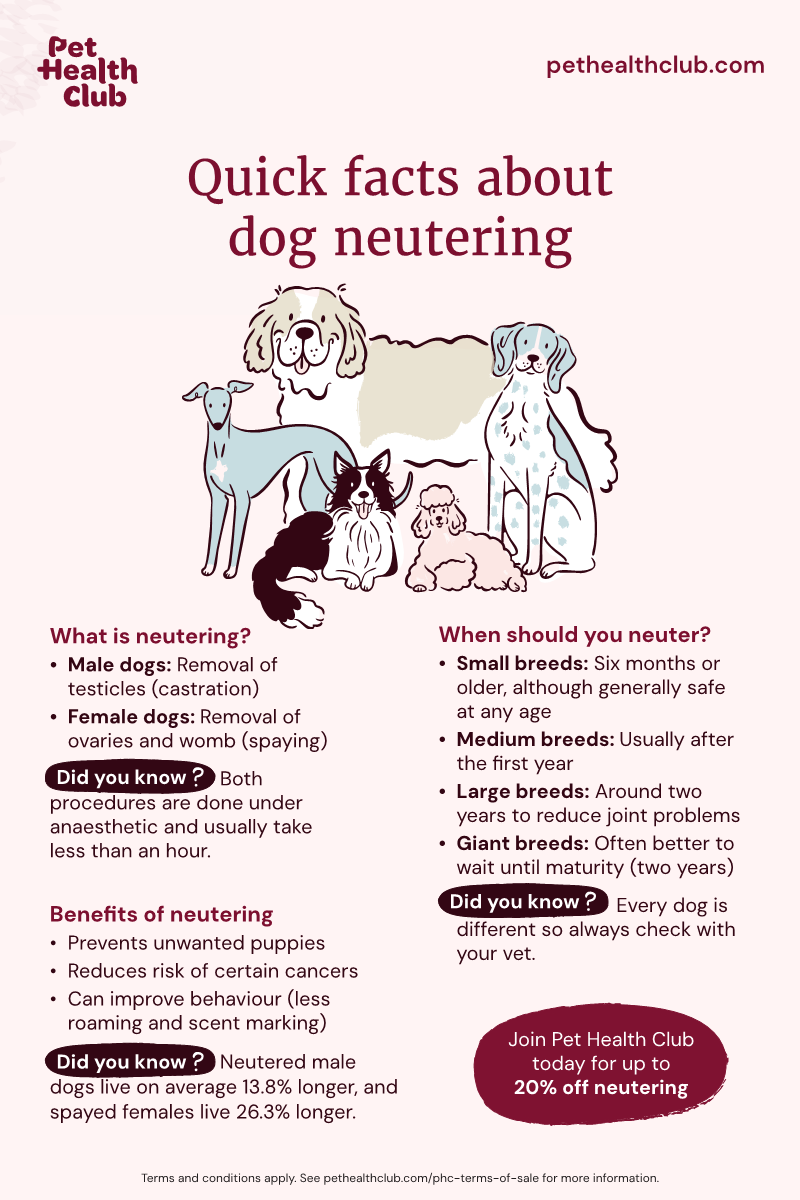
Read more: Dog neutering advice
Neutering female dogs
For female dogs, neutering (spaying) prevents unwanted pregnancies and helps protect against conditions like pyometra (a serious womb infection), uterine and ovarian cancer, and mammary tumours. It can also stop phantom pregnancies, which can be distressing. Spaying is often recommended if you're not planning to breed from your dog. Certain behavioural conditions in female dogs may also improve with neutering.
When is the right time to neuter?
There’s no one-size-fits-all answer. Many vets recommend neutering intact dogs before habits like roaming or marking become ingrained and difficult to manage, often around six to nine months of age. Large breeds may benefit from waiting a little longer to support joint development. Your vet will help you choose the right timing based on your dog’s breed, size, behaviour and health.
Benefits of neutering your dog
Neutering can help:
reduce behaviours like mounting, marking and roaming
prevent certain cancers and prostate problems
reduce the risk of injury from roaming or fighting
prevent unwanted litters
support focus and training
improve long-term health and may increase lifespan
If you’ve been wondering about the signs your dog needs to be neutered, noticing changes in your dog's behaviour or health could be a helpful prompt to talk to your vet. Remember, the decision should be based on your dog’s individual needs.
What the neutering procedure involves
Neutering is a routine operation under general anaesthetic. In intact male dogs, the testicles are removed. In females, it usually involves the ovaries and uterus. Most dogs are able to go home the same day and recover within a week or so. Your vet will guide you through the aftercare, including keeping the wound clean and avoiding strenuous activity.
Things to consider before neutering your dog
Like all surgery, neutering carries a small risk, though complications are rare. Your dog may need fewer calories afterwards, so it’s important to adjust their diet to avoid weight gain. In large breeds, early neutering has been linked to a slight increase in joint issues, and some cancers are still being studied. If you're unsure, your vet can talk through the pros and cons, and you might also consider temporary alternatives like chemical castration, which can give you a sense of how your dog might respond.
What research says about neutering and behaviour
A 2024 review by Arroube & Pereira supports a personalised approach to neutering. It found that while neutering can reduce some unwanted behaviours, especially in males, it may also increase fear, anxiety or reactivity in certain dogs, particularly when carried out early or without considering breed, size or temperament. The review highlights that behavioural outcomes after neutering can vary and aren’t always predictable.
A separate 2024 study of mixed-breed male dogs found that neutered dogs were more likely to show stress, aggression and reduced sociability compared to intact males, especially in small and medium dogs. While neutering can reduce hormone-driven behaviours like roaming or mounting, it’s not guaranteed to resolve all issues and may come with behavioural trade-offs in some dogs.
Warning signs after dog neutering
Neutering is a routine procedure, and most dogs bounce back quickly. But like any operation, it’s important to know what’s normal and what’s not. Keep an eye on your dog during the first few days and contact your vet if you notice any of the following, as they could be signs of infection, discomfort, or a complication that needs checking:
Redness, swelling, or discharge around the wound
Bleeding or the wound opening up
Foul smell from the surgery site
Excessive licking or chewing at the area
Lethargy or low energy beyond the first day
Refusing food for more than 24 hours
Ongoing vomiting or diarrhoea
Shivering or signs they’re in pain
Need to know more about neutering?
If you're not sure whether neutering is right for your dog, or you’re seeing any signs mentioned here, speak to your vet using our Find a Vet tool. They’ll help you weigh up the options and decide what’s best for your dog’s health, wellbeing and lifestyle. Factors like breed, body size, personality and your dog’s daily routine can all influence the outcome. Members of Pet Health Club get up to 20% off surgical neutering.
Show references
American Veterinary Medical Association (AVMA), 2021. Spaying and neutering. [online] AVMA. Available at: https://www.avma.org/resources/pet-owners/petcare/spaying-and-neutering [Accessed 26 May 2025].
Cornell University College of Veterinary Medicine, n.d. Castration (neutering) in dogs. [online] Available at: https://www.vet.cornell.edu [Accessed 26 May 2025].
VCA Animal Hospitals, n.d. Neutering in dogs. [online] VCA Hospitals. Available at: https://vcahospitals.com [Accessed 26 May 2025].
ASPCA, n.d. Pet care: Neutering your male dog. [online] ASPCA. Available at: https://www.aspca.org [Accessed 26 May 2025].
University of California Davis School of Veterinary Medicine, 2020. Long-term health risks and benefits associated with spay / neuter in dogs. [online] Available at: https://www.vetmed.ucdavis.edu [Accessed 26 May 2025].
British Veterinary Association (BVA), 2022. Neutering your pet. [online] BVA. Available at: https://www.bva.co.uk [Accessed 26 May 2025].
Hart, B.L., Hart, L.A. and Thigpen, A.P., 2020. Neutering of German Shepherd dogs: associated joint disorders and cancers. Veterinary Medicine and Science, 6(2), pp.279–287. DOI: 10.1002/vms3.135.
Medically reviewed by Lizzie Youens, BSc(Hons) BVSc MRCVS
Published on 09/06/2025 • Reviewed on 16/06/2025