

Overview
Finding a lump on your dog can be alarming — but in many cases, there’s no need to panic. Lumps can be harmless and common, especially as dogs get older. These might include fatty lumps, cysts, or skin growths that don’t pose a threat to your dog’s health. Others, though less common, could be more serious and need treatment.
It’s important to know what to look out for and when to seek advice. The sooner a lump is checked by a vet, the sooner you’ll know what it is — and what to do next.
How do vets classify lumps and bumps?
When your vet checks a lump, they’ll usually try to find out:
Is it a tumour or something else? A growth doesn’t always mean cancer — some lumps aren’t tumours at all. They could be abscesses (caused by infection), cysts (from blocked glands), or reactions to an injury, injection, or even something under the skin.
Is it benign or cancerous? Benign lumps are generally slow growing and don’t spread to other parts of the body. Cancerous ones might grow rapidly, invade into nearby tissue or spread elsewhere. But you can’t tell just by looking or feeling. Some harmless lumps feel firm or look sore, and some cancerous ones feel soft.
Because many lumps look and feel alike, your vet may take a small sample of your dog’s lump using a fine needle or suggest a biopsy (this is where a small tissue sample is taken to be checked under the microscope) to find out more information and help decide on a treatment plan (if needed).
What are the most common benign lumps on dogs?
Most lumps on dogs turn out to be harmless. They often grow slowly, don’t hurt, and rarely spread. But even a benign lump can get irritated or infected — getting a lump checked is never a bad idea.
Lipomas (fatty lumps)
These soft, fatty lumps sit just under the skin and are often found on your dog’s chest, tummy, or legs. Known as lipomas, they’re common in older or overweight dogs. Most grow slowly, don’t cause pain, and are usually harmless. Vets often check their size at routine visits and leave them alone unless they affect how your dog moves or feels.
There are rarer types of fatty lump too. Infiltrative lipomas can grow faster and spread into nearby tissue like muscle, making them harder to remove. Another rare kind, liposarcoma, is cancerous — but it can look just like a harmless lipoma at first. That’s why it’s always worth getting any lump checked properly.
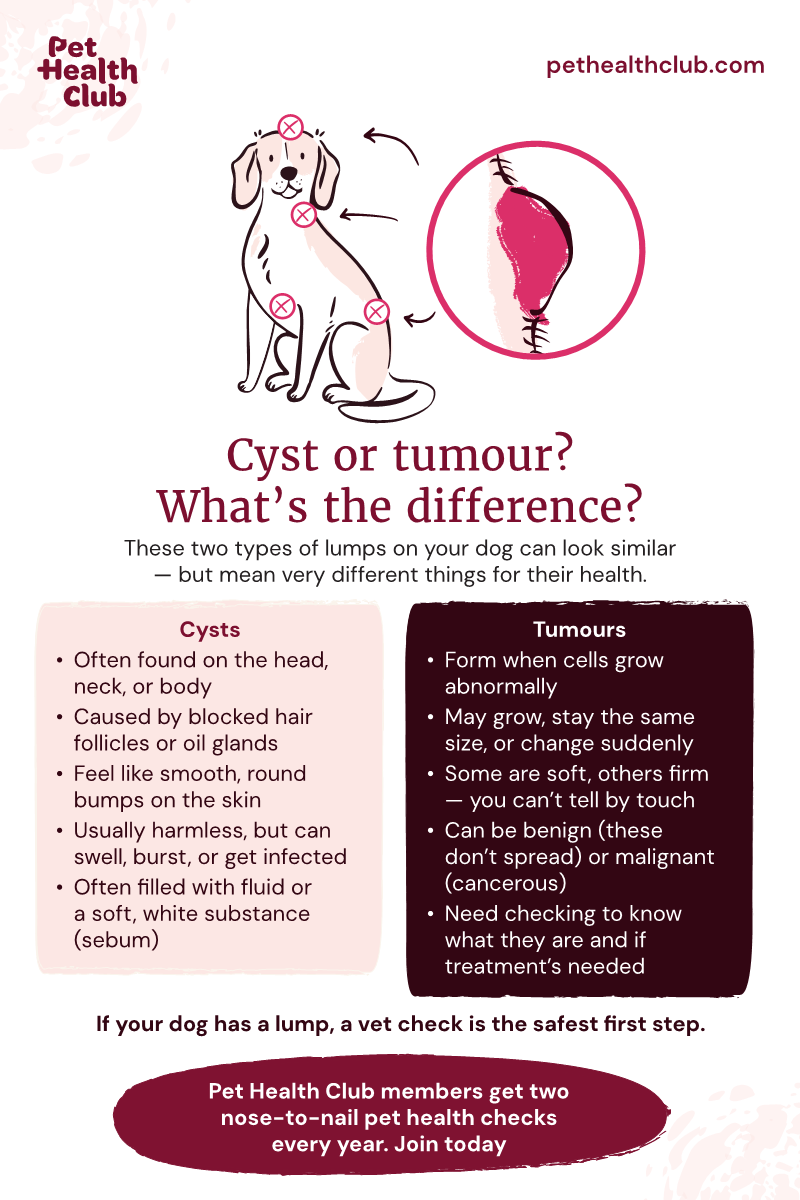
Sebaceous cysts and follicular cysts
These small, round lumps form when a skin gland gets blocked. They can look a bit like raised spots and often contain soft, white material (known as sebum). Sebaceous cysts usually show up on your dog’s head, neck, or body. They also can burst on their own. They’re usually harmless, but can become sore or infected. If a cyst keeps coming back or causes trouble, your vet might suggest removing it. Never try to pop one at home — it can cause infection or leave a scar.
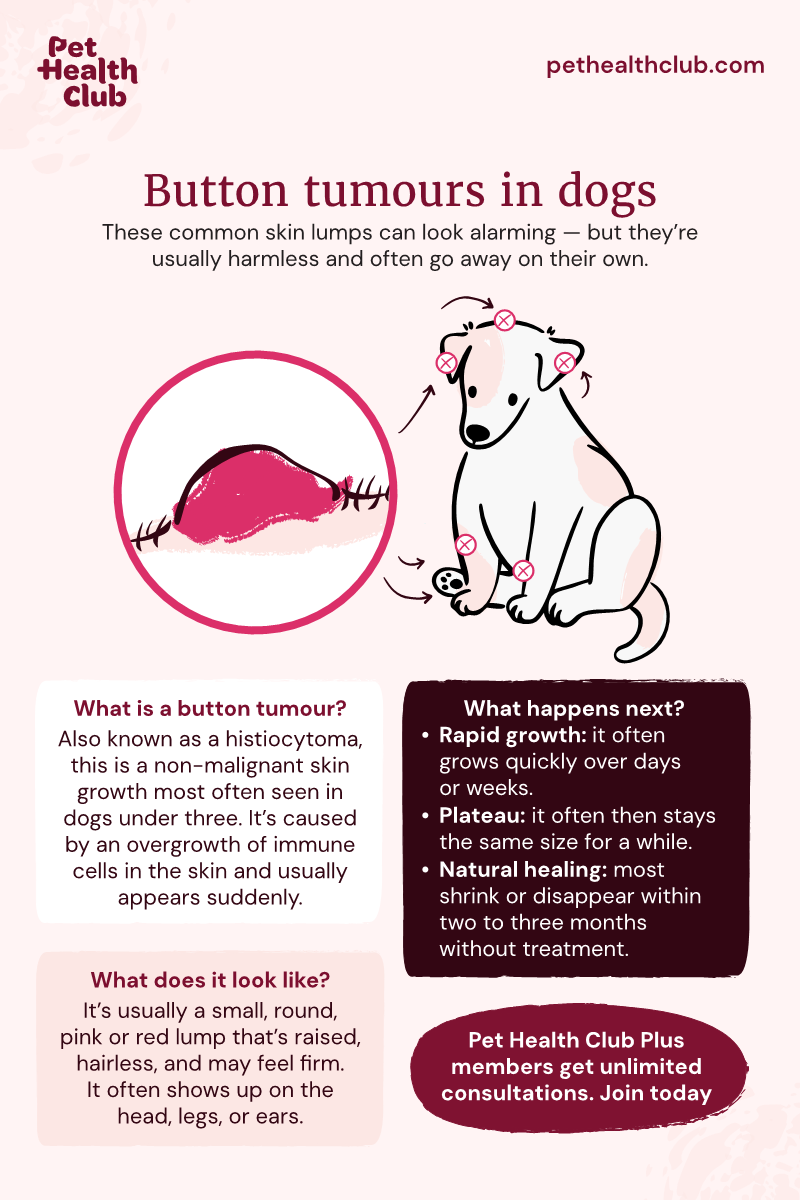
Histiocytomas ("button tumours")
These red, raised lumps often appear suddenly, especially in younger dogs under three. They can look sore but are usually harmless and not painful. Histiocytomas tend to show up on the head, ears, or legs and are one of the few lumps that often disappear on their own within a couple of months. Even so, it’s always worth having them checked to rule out anything more serious, as they can look extremely similar to the more concerning mast cell tumours.
Read more: Your puppy's first health check
Warts (papillomas)
Warts in dogs are caused by a virus and are most common in puppies or dogs with weaker immune systems. They often appear in clusters around the mouth, eyes, or feet and look like small, pale, cauliflower-like lumps. Most clear up on their own, but if they grow or don’t go away, your vet might suggest removing them. As they spread through contact, it’s best to avoid shared toys and bowls while your dog has warts.
Not all wart-like lumps are caused by a virus. Older dogs can develop sebaceous gland tumours or nodular hyperplasia. Despite the scary names, these growths are usually harmless. They have different causes to warts, but can look similar. While often nothing to worry about, they can get sore or inflamed — so it’s still a good idea to have them checked.
Skin tags
Skin tags are soft, dangly bits of extra skin that often appear where your dog’s skin folds or rubs — like the armpits, chest, or under the collar. They’re more common in older dogs and are usually harmless, though they can sometimes get caught or irritated.
They come in different shapes and sizes. Some lie flat, while others hang from a thin stalk. Skin tags aren’t contagious and don’t usually need treatment unless they’re bleeding, changing in shape or size, or bothering your dog.
What are the common cancerous lumps?
Cancerous lumps need prompt attention, but often it’s not clear if a lump is cancerous until it’s been checked with a fine needle sample or biopsy.
Mast cell tumours
Mast cell tumours (MCTs) are one of the most common skin cancers in dogs. Sometimes called ‘the great imitator,’ they can look like almost anything — from a smooth bump to a red, inflamed sore. They can also change size from day to day depending on your dog’s histamine levels. Some dogs may feel itchy, swell up, or even have tummy upsets or vomit if the tumour releases chemicals into the body. MCTs can appear anywhere and may sit on or under the skin. Some feel soft and moveable, others firm, and the skin over them can sometimes become red, sore or ulcerated. Some breeds are more prone to MCTs, including Boxers, Pugs, Staffies, Boston Terriers, and French Bulldogs. Dogs can also develop more than one in their lifetime.
Outlook depends on how aggressive the tumour is and whether it has spread. Low-grade tumours are often cured with surgery, while high-grade ones may need extra treatment like chemotherapy, radiation, or antihistamines to manage symptoms. Because these tumours can behave unpredictably, early diagnosis and treatment are key.
Soft tissue sarcomas
This group of cancers includes fibrosarcomas, liposarcomas, and others. They often feel firm and immobile, and sit deep under the skin, usually on the limbs or body. These tumours may start off growing slowly and seem harmless, but they can spread into nearby tissue. Early removal gives your dog the best chance of a good outcome.
Squamous cell carcinoma
This type of skin cancer often appears as a crusty, ulcerated, or bleeding lump. It’s usually found on sun-exposed areas like the nose, ears, belly, or eyelids — especially in dogs with thin or light-coloured coats. These tumours can look like sores that won’t heal. Giving your dog shade and sun protection can help reduce the risk.
Melanomas
Melanomas in dogs can be harmless or cancerous. The malignant kind is more often found in the mouth, on the toes, or around the eyes. These may show up as dark, raised lumps or fleshy growths. Oral melanomas are the most common and tend to spread quickly, often causing drooling, bad breath, or trouble eating. Melanomas on the toes can lead to swelling, limping, or nail loss, while those in or around the eye may cause bulging, vision changes, or a change in eye colour. There are three main types:
Oral melanoma: the most common and often aggressive
Digital melanoma: found on the toes and sometimes mistaken for an infection
Ocular melanoma: appears in or around the eye
Treatment depends on where the tumour is and whether it has spread. Surgery is often the first step, but your vet may also recommend chemotherapy, radiation, or a melanoma vaccine to help improve outcomes. As always, early detection and treatment give your dog the best chance.
Mammary tumours
Mammary tumours are lumps that form along a female dog’s mammary chain, especially in older, unspayed dogs. They can be small or large, and while some are harmless, others are cancerous. Around half of all mammary tumours in dogs are malignant, but early treatment can make a big difference.
Spaying your dog when young greatly reduces the risk of mammary tumours. The more seasons your dog has been through, the greater the risk will be. These tumours can appear as single or multiple lumps, next to or between nipples, and may sometimes ulcerate or produce discharge. You might also notice swelling, skin changes, or discomfort. Though rare, mammary tumours can also occur in male dogs — and when they do, they’re more likely to be dangerous.
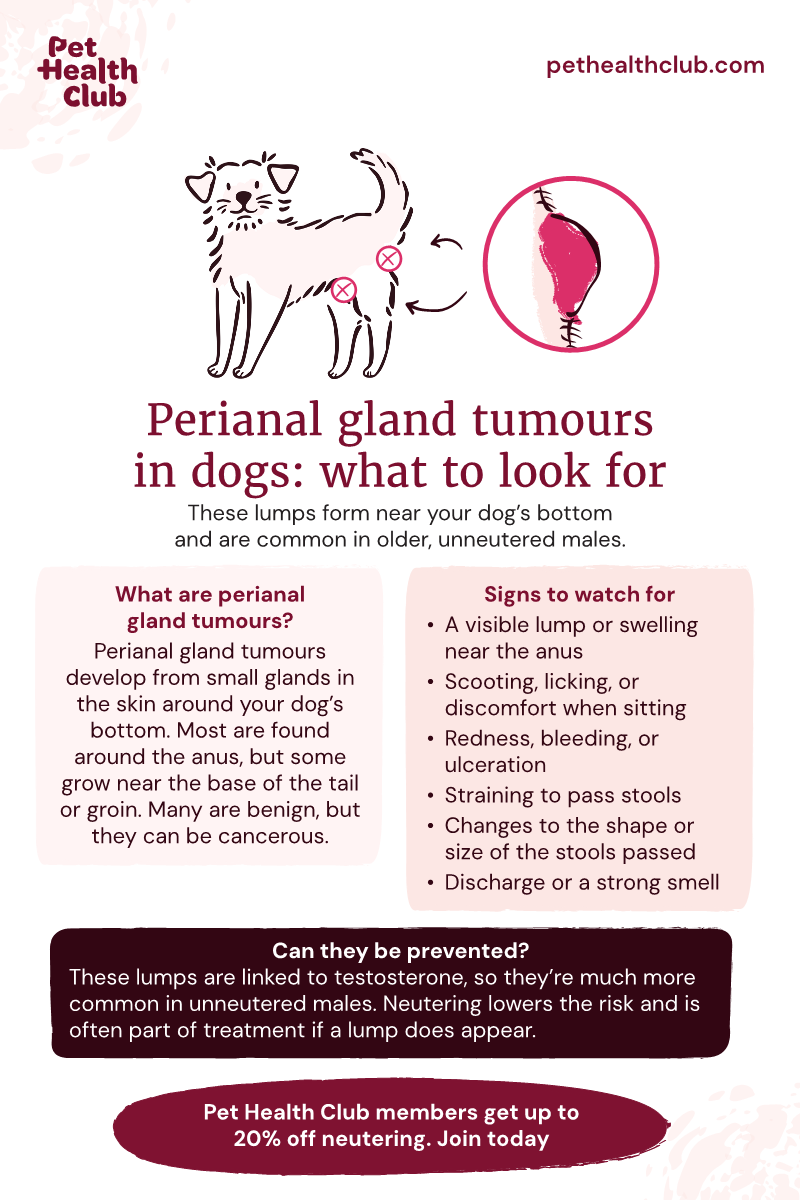
Perianal gland tumours
These lumps appear around a dog’s anus and are often hormone-related. They’re more common in older, unneutered males, though females can be affected too. Some are harmless (perianal adenomas), while others are cancerous (perianal adenocarcinomas). Adenomas are usually small, pink, and slow-growing, but they can ulcerate or become infected. In contrast, adenocarcinomas grow faster and may spread into nearby tissue.
Perianal adenomas are strongly linked to testosterone, so neutering is often the first step. In many cases, the lump shrinks or disappears afterwards. Malignant lumps usually need surgery, and a biopsy is key to finding out what type it is. Quick diagnosis is important — especially if the lump changes fast or causes discomfort.
Read more: Neutering in dogs
Other less common cancers
Other cancerous lumps may include anal sac adenocarcinoma (AGASACA) — a rare but aggressive tumour that develops in the anal sacs near the rectum. This type of cancer is more common in older dogs and can spread early to nearby lymph nodes, lungs, or abdominal organs. Signs may include swelling near the anus, straining to pass stool, scooting, lethargy, or increased thirst and urination (due to changes in calcium levels). The outlook is better if the tumour is small (less than 2.5 cm) and before it has spread.
Other rare skin cancers, such as cutaneous lymphoma or haemangiosarcoma, may also appear as lumps or changes to the look and feel of the skin. Internal tumours in organs like the liver or spleen can also be felt under the skin, but only if they grow large.
Could a lump be something else?
Some lumps might look or feel like tumours but aren’t growths at all. Sometimes what appears to be a lump could turn out to be a parasite, a symptom of an allergic reaction, or a different type of swelling altogether. But even if your dog’s lump isn’t a growth, it could still be something which needs veterinary attention.
Abscesses
Abscesses are painful swellings filled with pus, usually caused by bites, scratches, or things like grass seeds getting under the skin. They can grow quickly and often feel warm, soft, or squishy and may be painful or sore when touched. Dogs may lick the area, seem tired, or run a fever. If they burst, abscesses can release pus which may smell unpleasant. They need to be drained and flushed by a vet and may require antibiotics — they should never be squeezed at home.
Seromas and haematomas
Seromas are soft, fluid-filled swellings that often show up after surgery or injury, usually near the surgical site — like after a spay or lump removal. They’re normally painless and harmless but should be monitored in case they become infected or indicate a problem with an underlying injury or wound.
Haematomas are pockets of blood that form under the skin after trauma. They feel firmer and are often seen in a dog’s ear flap after lots of head shaking, such as due to an ear infection or injury. While some seromas and haematomas settle on their own, others may need draining or even surgery.
Enlarged lymph nodes
Lymph nodes can swell in response to infection, inflammation, or illness. They’re usually found under the jaw, in front of the shoulders, or behind the knees. A slightly enlarged node might just be part of the body’s normal immune response. But if several are swollen, or if the swelling feels firm and doesn’t go down, it could point to something more serious, like lymphoma. Healthy lymph nodes are soft to firm, small, oval, and moveable. If one feels very large, hard or fixed in place, it’s best to get it checked.
Injection site reactions
These small lumps can appear where your dog’s had a recent vaccination or injection. They’re usually painless and show up within a day or two. Most go away on their own within a week or two. In rare cases, more serious lumps can form at injection sites.
Ticks
Ticks are small parasites that latch onto your dog’s skin to feed on blood. Once attached, they can swell and feel like a lump, often around the ears, face, or paws. They may look grey or brown and have tiny legs. Always use a proper tick remover to take them off safely, and check the area for redness, swelling or infection. Ticks can carry diseases like Lyme disease, so removing them quickly and carefully is important.
What are the signs that my dog’s lump is dangerous?
Not all lumps are a cause for concern, but some changes could point to something more serious. Speak to your vet if you notice any of the following:
A lump that grows quickly or suddenly changes size
A firm lump that feels fixed in place
A lump that bleeds, weeps, or becomes sore
A lump that seems painful or makes your dog flinch when touched
Changes in colour, texture, or surface of the skin or a skin growth
Several new lumps appearing at once
General signs of illness like weight loss, low energy, or loss of appetite
These signs don’t always mean cancer, but they do mean your dog should be checked. Spotting problems early can make a big difference to treatment and recovery.
How do vets diagnose lumps in dogs?
Once your vet has examined your dog and taken a history, they may recommend one or more of the following tests:
Fine needle aspiration (FNA): a small needle collects a few cells from the lump. This is usually quick, doesn’t need sedation, and can often be done during a consultation. The sample is checked under a microscope for signs of infection, inflammation or cancer.
Biopsy: if the FNA doesn’t give clear answers, your vet may suggest a biopsy. This involves taking a small tissue sample — or removing the lump — under sedation or anaesthetic. The sample is then sent to a lab for a more detailed check.
Imaging: for larger or deeper lumps, or if the vet suspects it may affect internal structures, X-rays or ultrasound may be used to see how far it extends and whether other areas are involved.
These tests help your vet work out what the lump is and what treatment, if any, is needed. Testing early helps guide the best care for your dog.
How do I check my dog for lumps?
Keeping an eye on your dog’s skin and coat is one of the simplest ways to spot changes early. Here are some easy tips:
Routine checks: run your hands over your dog each week during grooming or cuddle time. Focus on common lump areas like the chest, tummy, legs, and underarms.
Measure and monitor: if you find a lump, measure it with a coin or ruler and take a clear photo. Check again every couple of weeks to see if anything’s changed.
Keep a lump log: note when you first saw the lump, its size, where it is, what it feels like, and any changes. This gives your vet a clearer picture over time.
Don’t guess or squeeze: never try to diagnose or pop a lump at home.
Even small or harmless-looking lumps can become infected or turn out to be more serious.
By staying alert and keeping records, you’ll be in the best position to catch problems early — and help your vet give your dog the right care.
Dog lumps and bumps FAQs
What’s the difference between a cyst and a tumour?
A cyst is a sac filled with fluid or debris, often caused by a blocked gland or hair follicle. They’re usually harmless and may shrink or burst on their own. A tumour is an abnormal growth of tissue and can be either benign (non-cancerous) or malignant (cancerous). Because both can look and feel similar, it’s important to get any new lump checked by your vet.
Read more: The importance of routine health checks for dogs
Can benign dog lumps turn into cancer?
Most benign lumps don’t turn cancerous. But some tumours can seem harmless at first but turn out to be dangerous. For example, lipomas don’t become cancer, but what appears to be a lipoma might turn out to be a cancer like liposarcoma.
Do dogs get more lumps as they age?
Yes — older dogs often develop more lumps and bumps over time. Many are harmless, but it’s still worth having each new lump checked, just to be sure.
How quickly should I act if I find a lump?
If a lump has been there for more than two weeks, is growing, or seems to bother your dog, it’s best to book a vet appointment. Even if it’s small or not causing problems, early checks are always a good idea.
Will my dog need surgery to remove the lump?
Not always. Many harmless lumps can just be monitored. Vets tend to recommend surgery if the lump is growing, becoming irritated, or is in a place that affects your dog’s movement or comfort.
Can lumps come back after removal?
Yes — some, like sebaceous cysts or histiocytomas, can return. Cancerous lumps might also come back if they weren’t fully removed. That’s why vets may suggest extra tests or follow-up visits to keep an eye on things. Adjunctive treatments such as chemotherapy or radiotherapy may be suggested after removal of some types of malignant cancers to reduce the likelihood that they will return.
What does it mean if a lump is ‘ulcerated’?
An ulcerated lump has broken open or turned into a sore on the surface. This can happen with both harmless and cancerous lumps. It usually needs prompt vet attention to help prevent infection or further problems.
Are certain breeds more prone to lumps?
Yes — some breeds like Boxers, Pugs, Golden Retrievers, and Cocker Spaniels are more likely to develop certain types of lumps, including mast cell tumours, lipomas, and sebaceous cysts. Your vet can tell you if your dog is at higher risk.
Can lumps be caused by insect bites or stings?
Yes — insect bites can cause short-term lumps or swellings. These usually settle within a few days, but it’s worth keeping an eye on them in case they get worse or become infected.
Do dogs feel pain from lumps?
Not usually. Most lumps aren’t painful unless they’re sore, inflamed, or pressing on something like a nerve or joint. If your dog flinches, licks, or avoids being touched near the lump, it’s best to let your vet know.
Need more info?
For more help and advice on dog lumps, or if you're concerned about a lump on your dog, have a chat with your local vet. Remember, members of Pet Health Club get two nose-to-tail healthy pet checks a year.
Find your nearest vet using our find a vet page.
Join the club today
Get regular health checks, vaccinations, and more, all included in your plan.

Medically reviewed by Lizzie Youens, BSc(Hons) BVSc MRCVS
Published on 16/01/2026 • Reviewed on 16/01/2026