

Overview
XL Bully-type dogs are officially banned. Ownership is illegal unless an exemption has been applied for and granted. They must also be on a lead and muzzled when in public. The law to sell, breed from, abandon, or give away an XL Bully came into force on 31 December 2023.
If your XL Bully was under seven months old on 31 January 2024, they must be neutered by 30 June 2025. Dogs aged between seven and 12 months on that date must have been neutered by 31 December 2024, and those 12 months or older must have been neutered by 30 June 2024. You can download a PDF version of our XL Bully ban infographic here.

Does this mean that if I own an XL Bully it will have to be put to sleep?
The guidance, issued by the UK government, is similar to rules for other breeds banned under the Dangerous Dogs Act 1991. The UK's chief veterinary officer clarified there wouldn't be a cull of the breed. Instead, owners were told to register their pets on the Index of Exempted Dogs for a fee. Almost 3500 "banned dogs" already live legally with owners in the UK under this scheme. Before a dog can be exempted, requirements like neutering, microchipping, and third-party insurance must be met. The dog must also be on a lead and muzzled in public.
Is it illegal to own an XL Bully?
Yes, unless your dog has been officially exempted, owning an XL Bully is now illegal throughout the UK. Each nation has its own rules and deadlines, so it’s important to know where you stand.
England and Wales
Since 1 February 2024, it’s been against the law to own an XL Bully in England or Wales without a Certificate of Exemption. The deadline to apply has passed, so if you didn’t register your dog in time, you are now breaking the law. Exempt dogs must be neutered, microchipped, kept on a lead and muzzled in public, and covered by third-party insurance. Owners must also keep their contact details up to date with DEFRA.
Scotland
The same law came into force in Scotland on 1 August 2024. You needed to apply for a Certificate of Exemption by 31 July 2024. If your dog is exempt, you must follow strict rules, including neutering, microchipping, insurance, and always using a muzzle and lead in public. These conditions must be met to keep your exemption valid.
Northern Ireland
In Northern Ireland, it became illegal to own an XL Bully without a Certificate of Exemption from 1 January 2025. Applications closed on 31 December 2024. Like the rest of the UK, exempt dogs must be neutered, microchipped, insured, and kept securely at home and under control in public.
In all cases
Even if your dog is exempt, it’s still illegal to breed from, sell, give away, or abandon an XL Bully. Breaking these rules could result in your dog being seized and legal action taken. If you’re ever unsure what applies to you, speak to your vet or check the official guidance for your part of the UK.
What is an XL Bully-type dog?
An XL Bully-type dog is a larger and more muscular variant of the wider American Bully breed. It first emerged in the US in the late 1980s, when American Pit Bull Terriers and American Staffordshire Bull Terriers were crossed. Compared to other variants of the American Bully breed, such as the 'Micro', 'Pocket', 'Standard', and 'Classic', the XL Bully is distinguished by its greater size, both in terms of height and body shape. This makes the XL Bully a standout within the Bully breed family for its physical presence. While the American Bully got recognition from the US United Kennel Club in 2013, it's not recognised by the UK Kennel Club or the American Kennel Club.
What should I do if I own an XL Bully?
If your XL Bully is already exempt, your focus now should be on meeting all the ongoing legal requirements. That includes keeping them neutered, microchipped, muzzled and on a lead in public, and making sure you have valid third-party liability insurance. You’ll also need to keep your contact details up to date with the relevant authority and let them know if your dog dies or is rehomed abroad.
Each UK nation has its own deadlines for when neutering needs to be confirmed. This depends on how old your dog was when the rules came into effect where you live. If you’re unsure, speak to your vet or check the official guidance.
If your dog isn’t exempt, and you missed the application deadline, the law sadly doesn’t allow you to keep them. We know that’s distressing, and if you’re facing this situation, your local authority or the welfare team at your vet practice can help you understand what steps to take next.
How do I know if my dog is classed as an XL Bully?
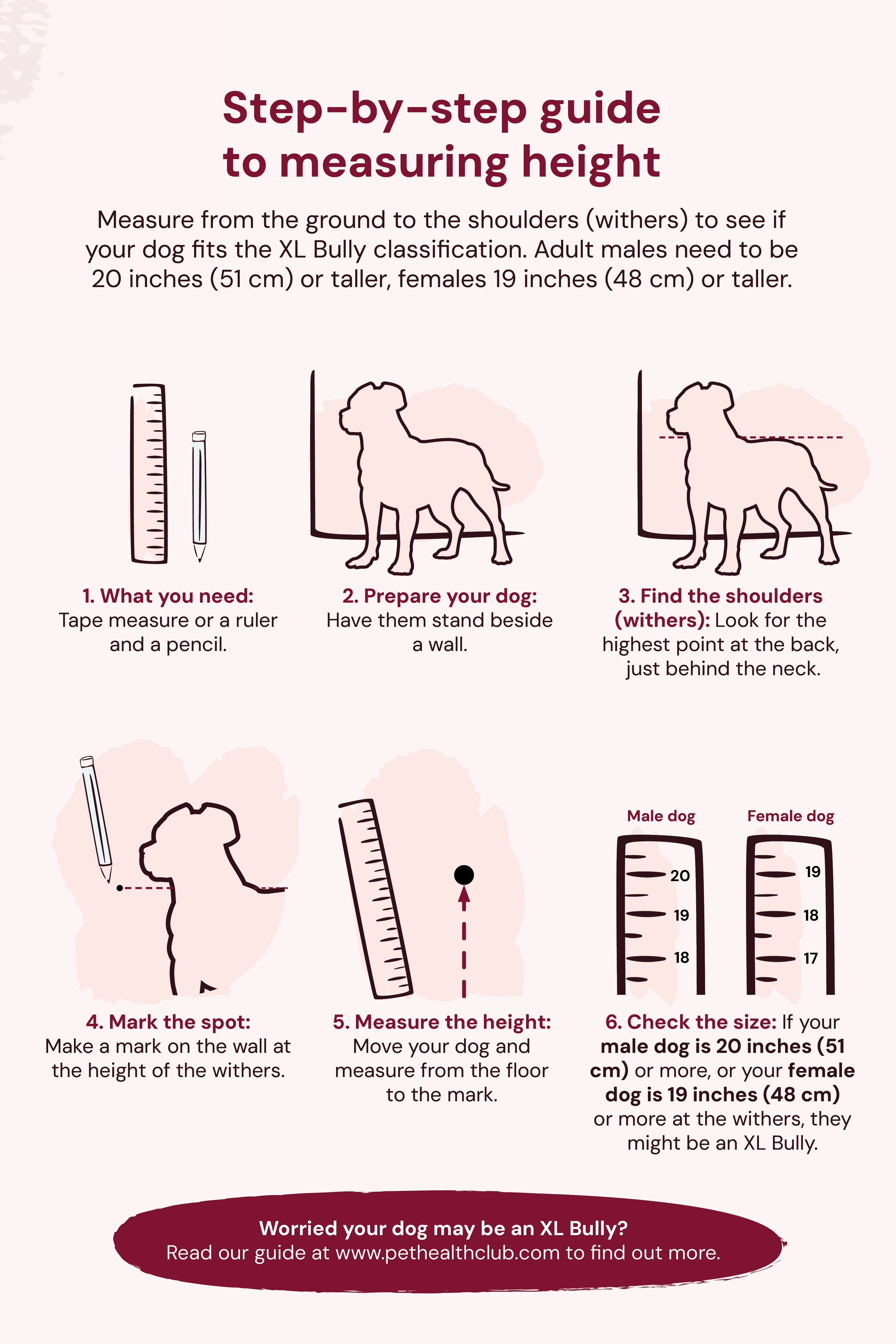
Worried about your dog being classified as an XL Bully under these new regulations? Our downloadable guide to identifying XL Bully dogs helps you determine and size up the breed's main characteristics. Learn what you need to do to make sure your dog continues to be a lawful part of your household.

What are the rules for exempt dogs?
If your XL Bully has been granted a Certificate of Exemption, there are strict rules you need to follow to keep your exemption valid:
Your dog must always be muzzled and on a lead in public, held by someone aged 16 or over
At home, they must be kept in secure conditions so they can’t escape
Your dog must be microchipped and registered with up-to-date details
You must have third-party public liability insurance to cover any potential incidents
Your dog must be neutered by the deadline that applied when the ban came into effect in your part of the UK
You must keep your Certificate of Exemption safe and be able to show it to a police officer or dog warden if asked
What about other banned breeds?
The Dangerous Dogs Act 1991 already bans the Pit Bull Terrier, Japanese Tosa, Dogo Argentino, and Fila Brasileiro. Backing, selling, giving away, or abandoning these types of dogs is illegal.
Are other large breeds like the Cane Corso and Presa Canaria included in the ban?
The government is aware that banning XL bullies may result in other breeds, such as the Cane Corso or Presa Canaria, becoming fashionable, and it is considering what to do in those circumstances. But it’s possible that other breeds and crosses between these breeds may be covered in the future.
Join the club today
Get regular health checks, vaccinations, and more, all included in your plan.

Medically reviewed by David Martin, BVSc MRCVS Clinical Director
Published on 21/09/2023 • Reviewed on 21/05/2024